
How You Answer These Three Questions Reveals the Cause of Your Team's Conflict.
Leadership teams argue.
They argue over being data-rich but insight-poor, the cost of updating the “tech-stack”, the brand being lost in translation, the exhaustion of chasing quick wins, and complaints being up. They even argue over who is next in line for the CEO’s seat.
All the while, Darryn from Accounts is betting his farm on AI to magically fix the company’s problems.
If the team is arguing, you’ve already missed the point of why teams argue.
Right now, people are in combat for what they, individually, want to experience at work and in life. It’s a complex conflict of interest, but it’s also very good for the evolution of business and, business is designed to do just that.
The problem is that too few leaders have worked this out.
Which means, the point leaders need to be addressing is not the comfort zones of finance, risk or operations. It’s not the programs or projects. It’s not the marketing. It’s not what Darryn does or doesn’t know. It’s far bigger, far more emotional and far more personal. Because the biggest portion of what makes a business turnover its cash is how it feels, which is more about what you, your customers, and employees are willing to buy into.
And right now, getting people to buy into anything is hard.
Which means, your real job, and the only way to stop your team from arguing, is by focusing on the experiences the business collectively creates for its people and delivering the experiences they actually want to buy into. And that means leading your Experience-Suite, not your C-Suite.
Every organisation has an Experience-Suite, whether the leaders at the top are aware of it or not. In fact, a simple lack of awareness here often causes leaders to destroy the very thing they’re trying to build.
Take, for example, the Chief of People & Culture who introduces a new collaborative platform to boost employee engagement. Their intention was never to make employees miserable. But because they fell head-over-heels for a fancy looking platform and bought it in isolation because it was within the budget, their attempt to deliver something good backfired. Instead of creating a culture where employees feel supported, they feel micromanaged, paranoid, and constantly watched. Darryn from Accounts now spends three hours a week reminding his team to jiggle their mouse so their status stays "online” to avoid “friendly” HR reminders. Meanwhile the Chief of People is scratching their head, wondering why Employee Experience scores dropped, and blames the employees’ “bad attitude” for the company’s plummeting productivity levels - entirely blind to the fact that their HR initiative just vandalised the company's psychological safety policy.
What happens in one domain of the Experience-Suite, positive or negative, has an impact on the whole. Which means, what the Chief of People & Culture actually did was turn the rest of the Experience-Suite domains against their own employees.
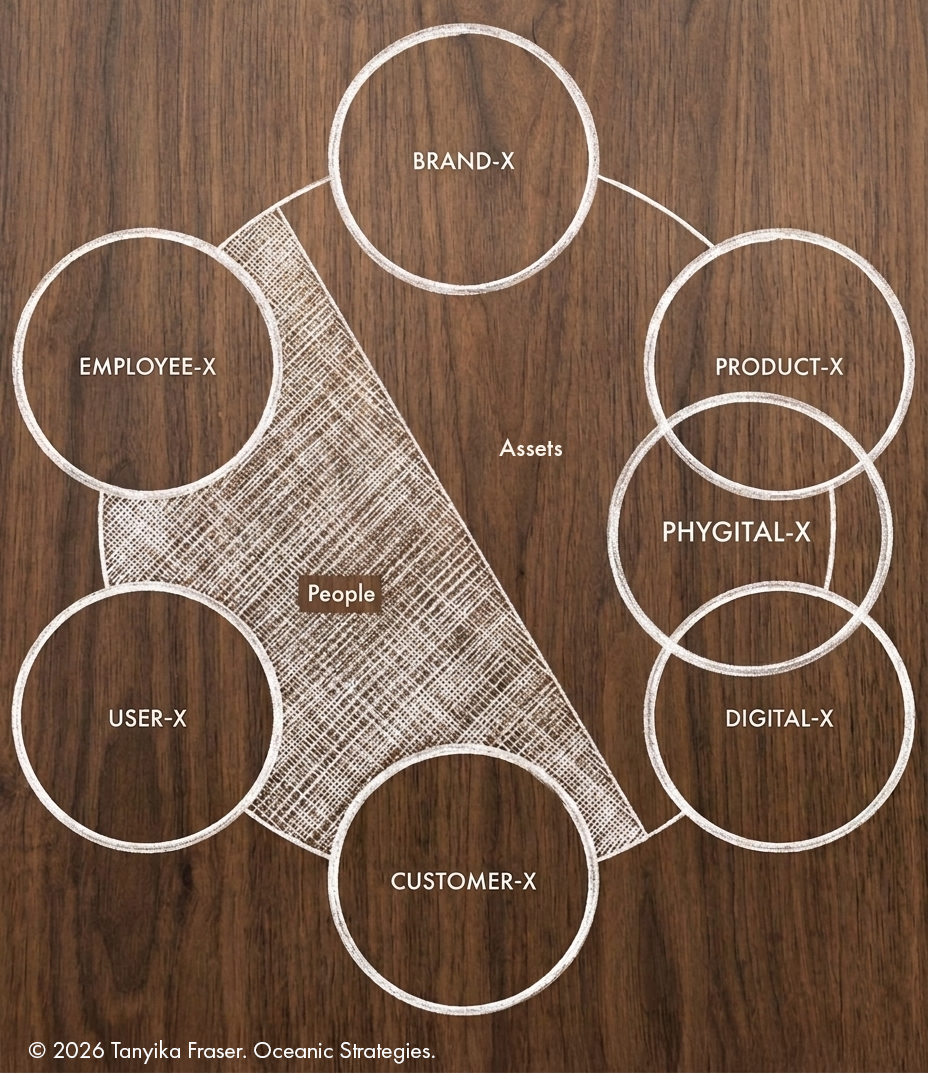
So, what exactly is the Experience-Suite?
The Experience-Suite is comprised of seven domains: Brand, Product, Phygital, Digital, Consumer, User, and Employee Experience. And to say it again, every single business is comprised of the entire Experience-Suite.
As far as diagrams go, it looks clean and sensible, right? In reality, it’s an absolute mess of overlapping accountabilities and egos. It creates division over what’s more important to the success of the company: people? or things? This is where the indecision, doubt and arguments creep in. It’s also where leadership focus is absolutely the most needed but is most often absent.
Consider, for example, your answer to these questions:
Which leader owns the brand identity on a digital dashboard in a vehicle?
Which leader owns the P&L for a pair of augmented reality glasses?
Who owns a digital platform used only by employees?
When you don’t have clear answers to questions like these — and when your answer excludes the word “experience” — then your business touchpoints become sources of conflict rather than growth. Because you’re not looking at the highest priority action you can take to make your business relevant to people. Which, ironically, is the only thing that will make a business succeed.
As a leader, your job isn't to hope all the adults on the team can work it out for themselves. They won’t, hence why they argue. Your job is to deliberately design these moments of overlap and set the direction for how your team is going to work in and around them. That’s important because the value in the culture — that’s the experience people buy into — is either created or destroyed specifically by what happens in those overlaps.
This means:
Leading with empathy for the end CUE (that’s your Customers, Users and Employees) - always, and ensure all team leaders do too.
Leading with the future in mind by ensuring all team leaders agree on the core experience you are trying to deliver to the world - that experience is the company vision.
Incentivising team leaders to collaborate on the grey areas and hit experiential KPI’s.
How you lead the Experience-Suite is the best predictor of how successful your team and your business will be and how many arguments they will or won't have. If you don't get this right, your people will forget about the big picture items — that’s driving innovation, growth and value — and instead focus on tasks like creating another dashboard or implementing new software, just so they have something to add to their performance review.
This article provides a top-level overview of the ‘Experience-Suite’ methodology. To learn more, grab your copy of The Experience-Suite via Amazon.
